"I dont ever want to feel, like I did that day. Take me to the place I love, take me all the way."- Red Hot Chili Peppers
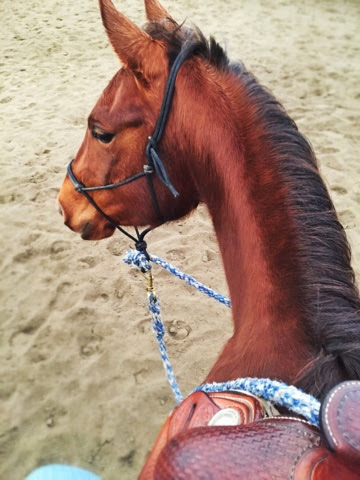
I came off Hola hard and broke 4 bones in my back and have since decided that maybe riding Hola wasnt such a good idea afterall... of course that didnt stop me from contemplating, (before I was even out of the ER) just who should be riding Hola.
Before we get to that...
What happened?
Hola spooked. She went from facing East to facing West approx ten feet away before I could so much as blink an eye. I made the mistake of trying to hang on even though my ass was no longer touching the saddle and I was instead clinging to her right side. FYI- clinging to a very green horse is a bad idea. In that moment I had magically transformed from her trusted leader to a giant, horse-eating cougar. She blew sideways, away from me. I didnt have far to fall.
Whenever I tell someone the cause of my injury their first question inevitably seems to be, "How tall is your horse!?" My face turns pink and cough something like *ehem* fourteen...ah... one...ish *cough* But then someone made the point that in fact her height could have played a role in the severity of my injury because I didnt have time to adjust. I came off sooooo fast and soooo hard and it was such a short distance to the ground that I hit harder than if I came off a tall horse...
Yah, I'm going to go with that. *shushes argument*
So I hit the ground, which was very hard packed crusher dust (like cement). I am pretty sure, given where I fell and the direction she blew that she intentionally tried not to step on me, for which I am grateful. Something about the way I fell, and the way that it hurt had me pause for just a second before I tried to stand up. I look at my feet and wiggled my toes. They moved so I stood up and thought... a naughty word.
"Oh. Okay, that hurts." I said. "Owe. I'm okay. I'm okay. I'm okay. Owe."
Then I did the cowgirl thing... I tried to walk it off. I thought surely just breathe through the worst of the pain and it will ease up in a minute. Brush it off. I've hit the ground enough times, I know that usually the adrenaline will kick in and it will stop hurting so bad...until a few hours later at least. I called for Laurie to go and grab Hola and drive her around in some circles. Laurie looked at my face and seemed concerned about leaving me but she went and caught up Hola and began working her. I tried to focus on that but I suddenly realized that I was going to be sick. And maybe pass out. I remember telling myself to suck it up but I couldnt get any air. "I've just knocked the wind out of myself' I thought, 'Relax and I will get some air.' But then I was hit with another wave of nausea that was so overwhelming, so acute I truly wished to be sick right then just to make the feeling go away. The ground would not hold still so I got down on my hands and knees.
Laurie and her husband quickly came over and I said, "I think I need to go to the hospital." The pain was just unreal and seemed to be intensifying rather than settling down. Laurie ran to get the car and pulled it around to the barn. I kept saying, "Im going to be sick and I think I'm going to pass out." over and over because I thought surely at any moment I was going to be sick or keel over and yet I didn't.
Clint said he was going to help me up and took me under the elbows to begin the walk to the car. I wasnt fully upright when, suddenly, I woke up. I was slummed on the ground and I had no idea where I was. I looked up and saw a lady walking towards me. The image shifted in to focus. I heard the lady say, "Did she pass out?" and then it came flooding back, the pain, the memory of my accident, where I was and that the lady was my dear friend Laurie and I was on the ground in Clints arms. "No, she just collapsed." He said. Oddly I felt the need to argue that I had, in fact, passed out. That point seemed important for some reason... maybe because for a brief moment I had felt nothing. I looked at the ground. I hadnt been sick. One humiliation less, nice.
While the pain came back, luckily the nausea had disappeared entirely as well as the feeling like I was going to faint. I was contemplating all of this when I heard myself ask, "What is that sound?" Is the hose on? I hear water running."
Neither Laurie or Clint answered, obviously focused on more pertinent issues.
"What is that sound?" I repeated. "Is there a hose on? Where is the water? I hear water."
Laurie, later would recount how the 911 operator was asking questions about my condition and whether I had hit my head. "Is she making sense? asked the operator. "No. No, she isnt." Laurie responded, her tone grave.
Only I was making sense. I was trying to find the source of this bizarre sound. It was everywhere around me but oddly not towards the barn. I could feel it buzzing in my ear, like a current behind me, to my left and to my right. On second thought it was not like water. It droned. And pulsed. I thought of the sound of high power lines. It was so acute and so bizarre it took my attention off the stabbing pain in my right hip. I have come to believe, however bizarre it may sound, that what I was hearing was actually the electric fence along the paddock rails.
Soon, that distracting sound was replaced by the approaching wail of ambulance's siren. My first thought, when the two male paramedics arrived, was how embarrassing it was that I had this accident. I repeated this ("How embarrassing" and "Im sorry") countless times over the coming hours. I still find it embarrassing, not that I fell but that I needed that attention. Both medics were so kind. Their purposeful but relaxed and positive attitudes immediately made me feel like help had really arrived... right up until they told me that I needed to roll down on to a board.
I had found, on my hands and knees, a little sweet spot where the pain was not quite so intense and the idea of having to get on to my back was too much to even contemplation. So they brought out the laughing gas (nitrous oxide) which unfortunately did little to make things funny( nor, unfortunately, painless) but oddly enough made me hear my own voice as a deep baritone, (it wasnt, I asked Laurie).
The nitrous oxide did cut the pain enough that I managed to roll myself on to the board and the medics got me strapped down. If I had known then that I would stay strapped to that board for the next five hours I might not have gone so willingly. Once on the gurney they began asking me questions, some to fill out the necessary paperwork and some of which were intended to test my mental faculties. Litttle would I have guessed that the question "How old are you?" would fall in to both categories.
"How old are you?"one paramedic asked.
"31" I quickly replied.
I heard Laurie softly tell the medic, "She's 32."
"Damn! That's right I am 32. That has nothing to do with hitting my head, I promise! I just can never remember how old I am." I exclaimed.
"That's okay" said the medic. "When is your birthday?"
I told him.
"Oh so you are just about 33 then." he said casually.
"Dammit! Just a minute ago I thought I was 31 and now I'm almost 33! Jeeze! I aged two years in the last two minutes. Hasn't this day been bad enough!"
I was cutting jokes while being loaded in an ambulance. God.
Once I was settled inside the paramedic took my blood pressure.
"What is your blood pressure normally?" he asked.
"115-125 over 75/80" I repled.
"Okay." He softly said. For some reason I keyed in on this and was then dying to know what my blood pressure was but I knew that if I asked him he probably wouldn't tell me or maybe he would lie so I didnt ask but instead stressed about whether I should or shouldn't be worried and if it was indicative of a larger problem or byproduct of the pain.
For the first few minutes I kept wiggling, trying to find a position where it would hurt less. I even went so far as to ask the medic if he could undo the straps so that I could change position. He looked at me with his kind, knowing eyes and said no that I needed to try and lay still.
That moment was when I realized that the pain meant something. It meant that I was hurt and that I really didnt know how bad.
I looked at the paramendic and asked, "It's just going to hurt isnt it?"
"Yes." He said softly.
"I just need to accept that then."
"Yes."
"Okay."
"Breath through it," He suggested. "Like Lamaze. Deep breath, in. Aaaand out."
I followed the breathing, which helped, but I think just accepting that I wasnt going to be able to move away from the pain and that I was going to have to ride it out was what got me in the right frame of mind.
When we arrived at the hospital my Mom, my DB, Laurie and my barn neighbor, Joan were all waiting for me. I guess Joan had run over when she saw the ambulance and decided to come to the hospital with Laurie, who had called my mom and DB. They put an IV and started fluids. I briefly met a doctor who said that he I needed to hang tight while he got me in for an MRI. Until then I needed to stay as still as possible and they would give me some morphine to help with the pain. A nurse came in and gave me a small amount of morphine, saying that we had to wait and see how I reacted before administering anything more. That first shot of morphine combined with my shock/adrenaline and immediately made me feel high as a kite. The pain was still there but oddly felt further away... like it was resting just above my hip rather than deep within it. That small amount of relief cleared my mind enough that I suddenly realized just how badly I needed to pee.
Part 2 soon.